


Leveraging Technology for Digital Engagement and Revenue GrowthIntroduction to Digital Engagement and Growth
In the dynamic digital landscape of July 2026, simply having an online presence is no longer enough. Businesses face a constant challenge: how to genuinely connect with customers amidst an overwhelming flow of information. True success now hinges on how deeply and meaningfully we engage with our audience online.
Digital engagement is no longer a buzzword; it is the primary engine for sustainable business growth and customer retention. It transforms passive interactions into active, value-driven relationships that foster loyalty and drive revenue.
This comprehensive guide will demystify Digital Engagement. We will explore its definition, differentiate it from traditional digital marketing, and highlight its critical role in building lasting customer connections. We will also delve into the key components of effective digital engagement strategies.
We will examine how businesses can leverage platforms like social media, mobile apps, and interactive tools. We will also look at the innovative role of solutions such as queue systems and self-service options.
Finally, we will address common implementation challenges. We will discuss how to measure the return on investment (ROI) of our digital efforts. We will also explore the exciting trends shaping digital engagement in 2026 and beyond, including advanced technologies such as Web3 fintech solutions.
Defining Digital Customer Engagement vs. Digital Marketing
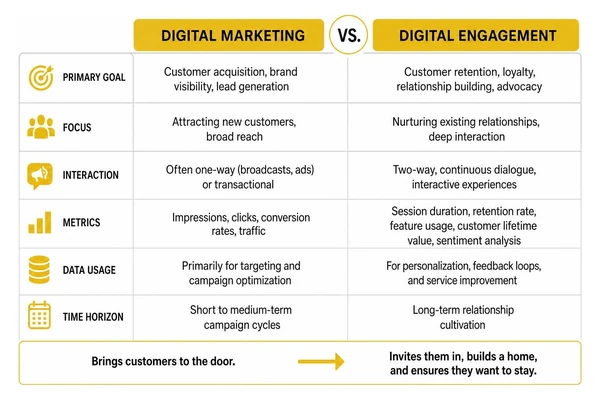
While often used interchangeably, digital engagement and digital marketing serve distinct, albeit complementary, purposes. Digital marketing primarily focuses on acquisition – attracting new customers and increasing brand visibility. Its goals revolve around reach, impressions, clicks, and conversions. Think of SEO efforts, paid advertising campaigns, and initial lead generation.
Digital engagement, on the other hand, shifts the focus to retention and fostering deeper, ongoing relationships with existing and potential customers. It’s about building value-driven interactions that encourage repeat participation, loyalty, and advocacy. Where marketing aims to get a customer’s attention, engagement aims to keep it, nurture it, and transform it into a lasting connection. This involves creating continuous interaction loops and leveraging valuable first-party data to understand and respond to customer needs in real-time.
Here’s a breakdown of their key differences:
Digital marketing brings customers to the door, while digital engagement invites them in, builds a home, and ensures they want to stay. Both are crucial for comprehensive business growth, but their strategies and outcomes differ significantly.
Why Digital Engagement and Growth Drive Customer Retention
Effective digital engagement is not merely a “nice-to-have”; it’s a fundamental driver of business growth and, most critically, customer retention. In an era where customer acquisition costs continue to rise-with some reports indicating they are 5 to 25 times higher than retaining an existing one-prioritizing engagement becomes an economic imperative.
A 5% increase in customer retention can boost profitability by a remarkable 25% to 95%. This statistic alone underscores the immense value of keeping customers engaged. When customers feel valued, understood, and connected to a brand, they are more likely to remain loyal, make repeat purchases, and even become brand advocates. This directly translates into a higher customer lifetime value (CLV), a crucial metric for sustainable growth.
Digital engagement fosters brand loyalty by enhancing the overall customer experience. Personalized digital experiences, for instance, have been shown to increase call-to-action (CTA) engagement by 68% and nearly quadruple the number of demo requests. This level of personalization, driven by insights from digital interactions, makes customers feel seen and appreciated, forging a stronger emotional bond with the brand.
Furthermore, engaged customers are more forgiving of occasional missteps, more likely to provide valuable feedback, and less prone to churn. They become a stable revenue source and often refer new business, creating a virtuous cycle of growth. Implementing well-thought-out digital engagement and growth strategies ensures that businesses not only attract customers but also actively cultivate a loyal community around their brand.
Key Components of an Effective Digital Engagement Strategy
Building a robust digital engagement strategy requires a multifaceted approach, integrating various elements to create a seamless, valuable customer journey. In July 2026, the most successful strategies are built upon three core pillars: omnichannel orchestration, hyper-personalization at scale, and intelligent automation powered by AI. Beyond these, a user-friendly experience and effective community building remain foundational.
Leveraging Social Media, Mobile Apps, and Interactive Tools
To truly drive engagement, businesses must effectively utilize the platforms and tools where their audience spends the most time.
The Role of Queue Systems and Self-Service Solutions
In the pursuit of seamless digital engagement, solutions that manage customer flow and empower self-reliance play a surprisingly significant role. Queue systems and self-service solutions, traditionally associated with operational efficiency, are now integral components of a customer-centric digital strategy.
By integrating these solutions, businesses can manage high-volume interactions more effectively, reduce friction points, and free up human agents to handle more complex, high-value customer interactions, ultimately enhancing the overall digital engagement ecosystem.
Overcoming Challenges and Measuring ROI in 2026 and Beyond
While the benefits of digital engagement are clear, implementing a successful strategy is not without its hurdles. Businesses in 2026 face several key challenges, including navigating complex data privacy regulations, avoiding channel overload, ensuring consistency in personalization, and overcoming technology adoption barriers.
Navigating Implementation Challenges and Measuring ROI
Successfully navigating these challenges requires a strategic approach to both implementation and measurement.
Measuring the return on investment (ROI) and effectiveness of digital engagement efforts is critical to proving their value and optimizing future strategies. This involves tracking a blend of leading and lagging indicators:
Future Trends in Digital Engagement and Growth
As we look towards 2026 and beyond, the landscape of digital engagement is poised for continuous evolution, driven by technological advancements and shifting customer expectations.
These trends point to a future where digital engagement is even more personal, intelligent, and integrated into every facet of the customer journey, requiring continuous adaptation and innovation from businesses.
Conclusion
Digital engagement has evolved from a competitive advantage into a business necessity. As customer expectations continue to rise, organizations that prioritize meaningful, personalized, and seamless digital interactions are better positioned to build lasting relationships, improve customer retention, and drive sustainable growth. From leveraging social media, mobile apps, AI-powered personalization, and self-service solutions to measuring ROI and adapting to emerging technologies, every aspect of a digital engagement strategy contributes to creating a stronger customer experience.
Looking ahead, the businesses that succeed will be those that remain agile, thoughtfully embrace innovation, and continually refine their engagement strategies based on customer insights and changing market trends. By investing in the right technologies while maintaining a genuine focus on customer needs, organizations can foster loyalty, strengthen their brand, and create long-term value in an increasingly connected digital world.